Built to Load Fast, Rank Well, and Last

Without Constant Maintenance

A website that takes 7 seconds to load, ranks on page three, and breaks every time WordPress updates is not an asset. It is a problem you pay for twice: once to build and once to fix. We build manufacturing websites on a foundation that prevents all three.

Why WordPress is the Right Choice for Manufacturing

We build on WordPress because it is the most practical long-term platform for manufacturing companies. Your team can update content without a developer. It supports the SEO and performance tools we use. Any developer anywhere can pick it up if you ever need outside help..

We do not use pre-built themes. Every site is a custom configuration built in Elementor Pro, structured to the Figma design system, and constructed component by component. That means it is faster, cleaner, and easier to maintain than a theme-based build — and it does not carry the performance penalty that comes from using a theme built for every industry at once.

use-of-wordpress

We also do not install every plugin that looks useful. Each plugin adds potential overhead and security risk. We install what is necessary, configure it properly, and document what it does.

What Goes Into Every Website We Build

Custom WordPress build

custom configuration built to the approved Figma design system

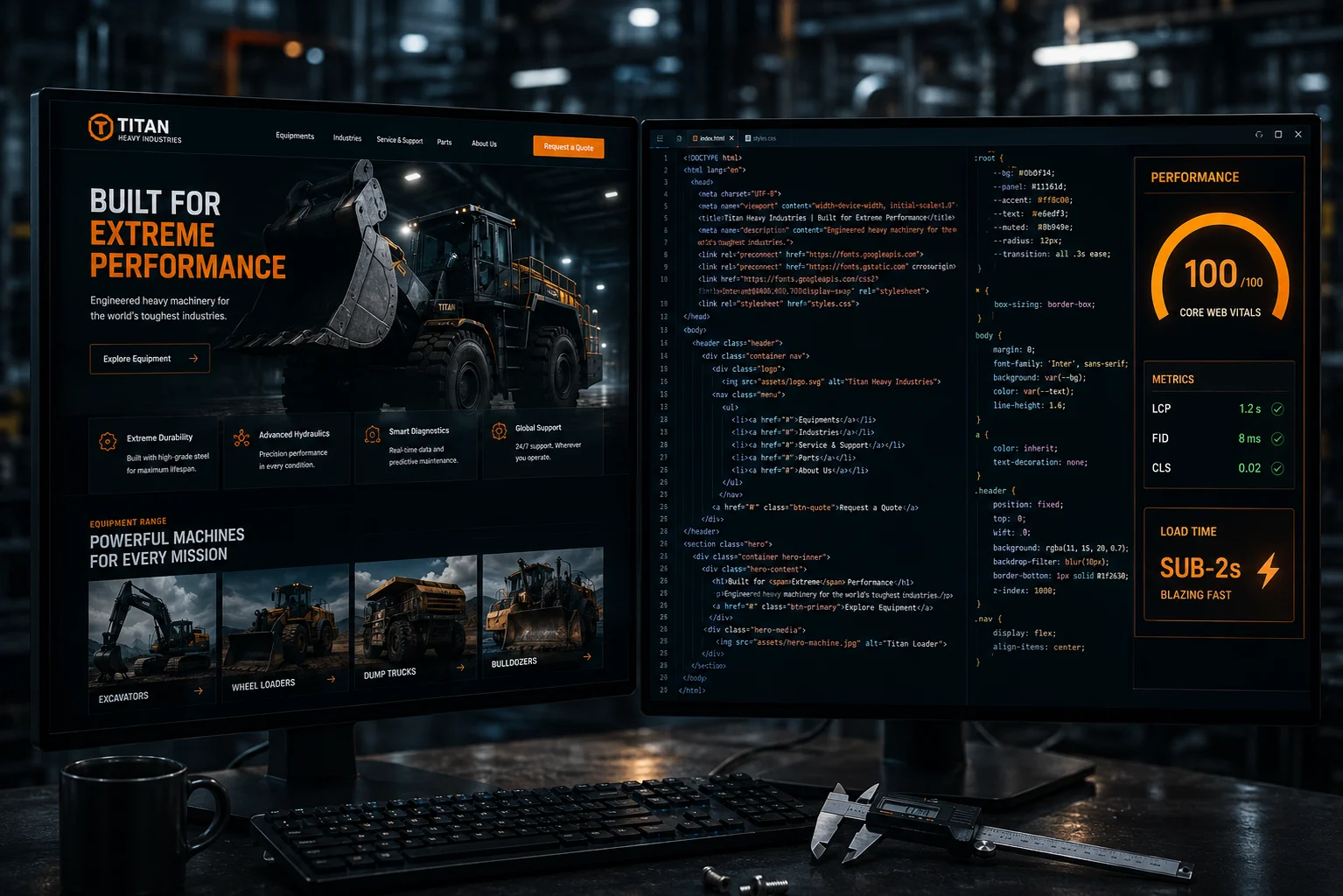
Core Web Vitals

verified through PageSpeed Insights at launch

Full schema markup

implemented across every relevant page

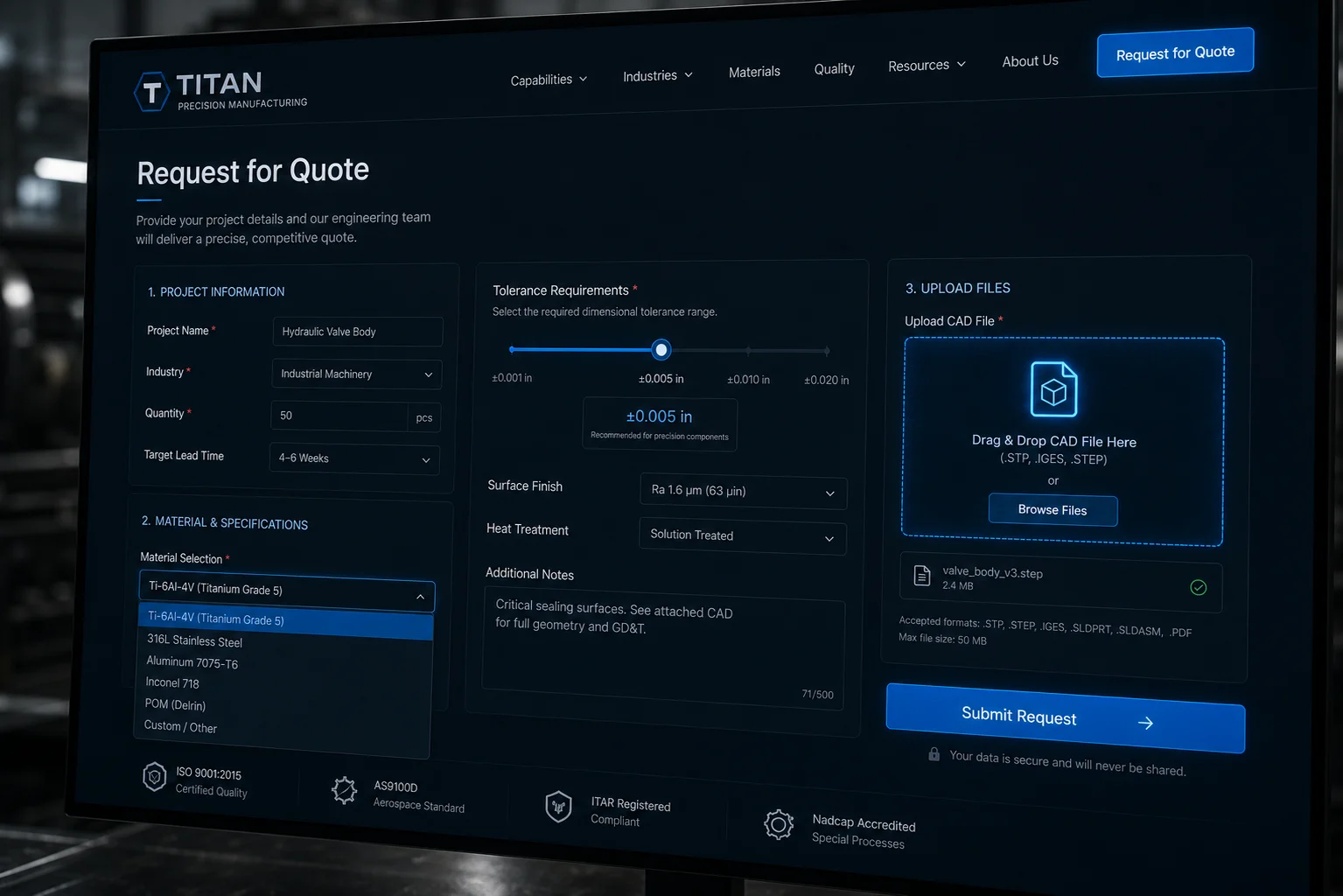
Enquiry form build

material selector, tolerance fields, CAD upload, auto-response configuration

CDN setup

caching and CDN configured for fast loading globally

GA4 & GSC

organized for fast evaluation by procurement officers

RFQ form design

conversion tracking for enquiry form submissions

XML sitemap

submitted to Google Search Console at launch

Security configuration

hardened WordPress installation, login protection, SSL, automated backups

Staging environment

set up for safe future updates; test before going live

CMS training session

One-hour session for your team on managing the site post-launch

Post Launch Support

minor changes if needed for free of costs

Core Web Vitals

Google measures website performance through three Core Web Vitals. We target all three on every site we build:

MetricWhat it measures and our target
Largest Contentful Paint (LCP)How quickly your most important visible content loads. Target: under 2.5 seconds. Achieved through CDN delivery, WebP images, CSS inlining, and server-side rendering of above-fold content.
Cumulative Layout Shift (CLS)How much content moves around as the page loads. Target: below 0.1. We set explicit dimensions on all images and media so nothing jumps during load.
Interaction to Next Paint (INP)How quickly the page responds when a buyer clicks something. Target: under 200ms. We minimize JavaScript payload and avoid heavy animation libraries that delay interaction.

Schema markup — built in as standard

Schema markup is structured data that tells Google and AI search tools exactly what your business is, what services you offer, and how to present you in search results. We implement the following on every manufacturing website we build:

Organization schema

company name, address, contact details, and sector

Service schema

each capability or service page marked up with structured data

FAQPage schema

every FAQ section structured so Google can extract Q&As as rich results

BreadcrumbList schema

navigation hierarchy for better search result presentation

HowTo schema

structured step-by-step content for AI tool citation

What 'AEO-Ready' Actually Means

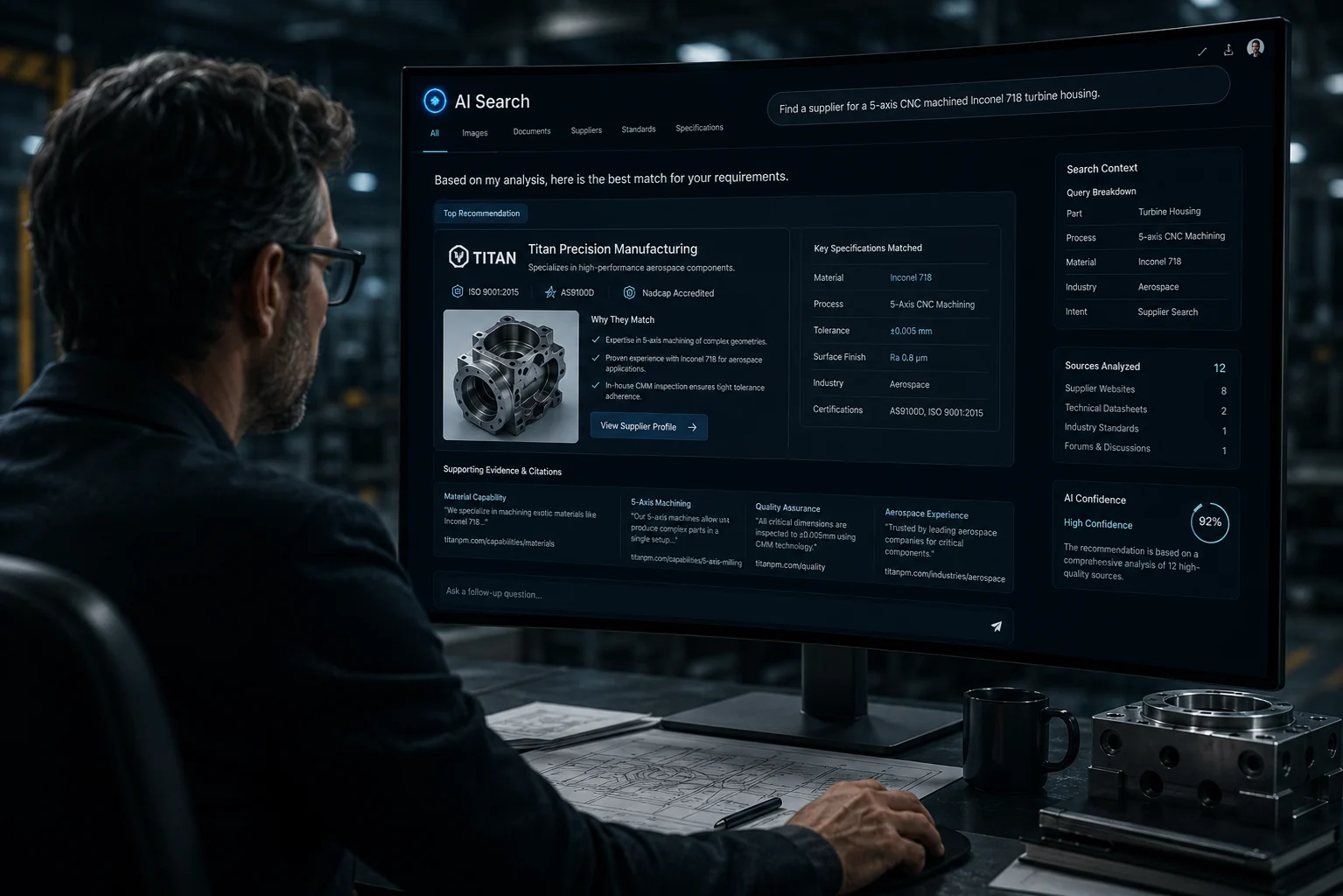
AEO-ready development means building a website so that AI search tools — Google AI Overviews, Gemini, Perplexity — can read every page, understand what your business does, and cite you accurately when a buyer asks those tools to recommend suppliers.

In practice, this means: implementing proper JSON-LD schema on every page, writing FAQ sections in a format AI tools can extract and cite directly, structuring content so the most important answer appears at the top of every section, and making sure your brand information is consistent across every page. We do all of this as the standard build — it is not an upgrade.

RFQ Form Engineering

A generic contact form is not an enquiry form. We build forms with the fields your buyers need to submit a real, specific enquiry — and that your team needs to evaluate it without a follow-up phone call. For CNC machining clients that means material selection, tolerance input, and CAD file upload. For pharmaceutical machinery clients it might mean product category and regulatory market. We match the form to your enquiry workflow.

4 Phases of Technical Web Engineering

Technical Site Audit

We analyze your current backend for bloat, security vulnerabilities, and "Code Debt."

Pixerts' strategic digital growth planning session showing B2B industrial web design ideation and industrial UX service mapping for a manufacturing client.

Architecture & 8px Mapping

We align the WordPress build with our UX/UI Design standards, ensuring pixel-perfect execution of the 8px grid.

A Pixerts lead developer engineering technical SEO frameworks and custom WordPress code for a B2B industrial web design project.

Core Web Vitals Optimization

We fine-tune server-side performance, image compression, and script loading for 100/100 speed scores.

A Pixerts digital growth specialist performing advanced industrial SEO and performance optimization to ensure a B2B manufacturing website ranks for high-intent keywords.

AEO & SEO Deployment

We inject semantic schema and technical SEO markers to prepare your site for a high-authority market launch.

A performance dashboard showing exponential growth in manufacturing RFQs and search visibility through Pixerts' B2B industrial marketing and paid growth strategies.
A successful partnership handshake between a Pixerts digital growth consultant and an industrial leader, representing the close of a manufacturing RFQ deal.

Connect with Pixerts to get expert consultation.

The Business Outcome:
A High-Performance Asset

Google rewards fast, mobile-responsive sites with higher visibility.

Technical researchers stay longer on a site that responds instantly.

You own the code, the environment, and the logic. No proprietary locks.

B2B web developer optimizing a high-performance industrial export dashboard at Pixerts.

B2B Industrial WordPress FAQ

What does AEO-ready development mean in practice?

It means building your website so AI search tools — Google AI Overviews, Gemini, Perplexity — can read every page, understand your business, and cite you accurately when buyers use those tools to find suppliers. In practice: FAQPage schema on every FAQ section, direct answers at the top of every major section, Organization and Service schema on every relevant page, and consistent entity information throughout. We build all of this into the standard development.

Yes. We build on WordPress so your team can manage content without a developer. We provide written documentation, a training session, and a maintenance checklist. Most updates — adding products, updating specifications, publishing blog posts — can be done by any team member after the training session.

We target a Largest Contentful Paint of under 2.5 seconds. Most sites we build land between 1.5 and 2.2 seconds on mobile. The exact result depends on hosting, image sizes, and design complexity — all of which we address during the build.

Development typically takes 3 to 4 weeks for a standard manufacturing website. The full project — design plus development — runs 8 weeks. Complex builds with custom integrations or large content volumes may take 10 to 12 weeks. The timeline is confirmed before the project starts.

Ready to Build a Manufacturing Website That Performs?

Tell us about your project. We will respond within one business day with a clear plan and straightforward pricing.

Two professional designers working on a high-fidelity B2B manufacturing website design, showcasing the benefits of a specialized industrial web design agency.
We Chat QR Code